
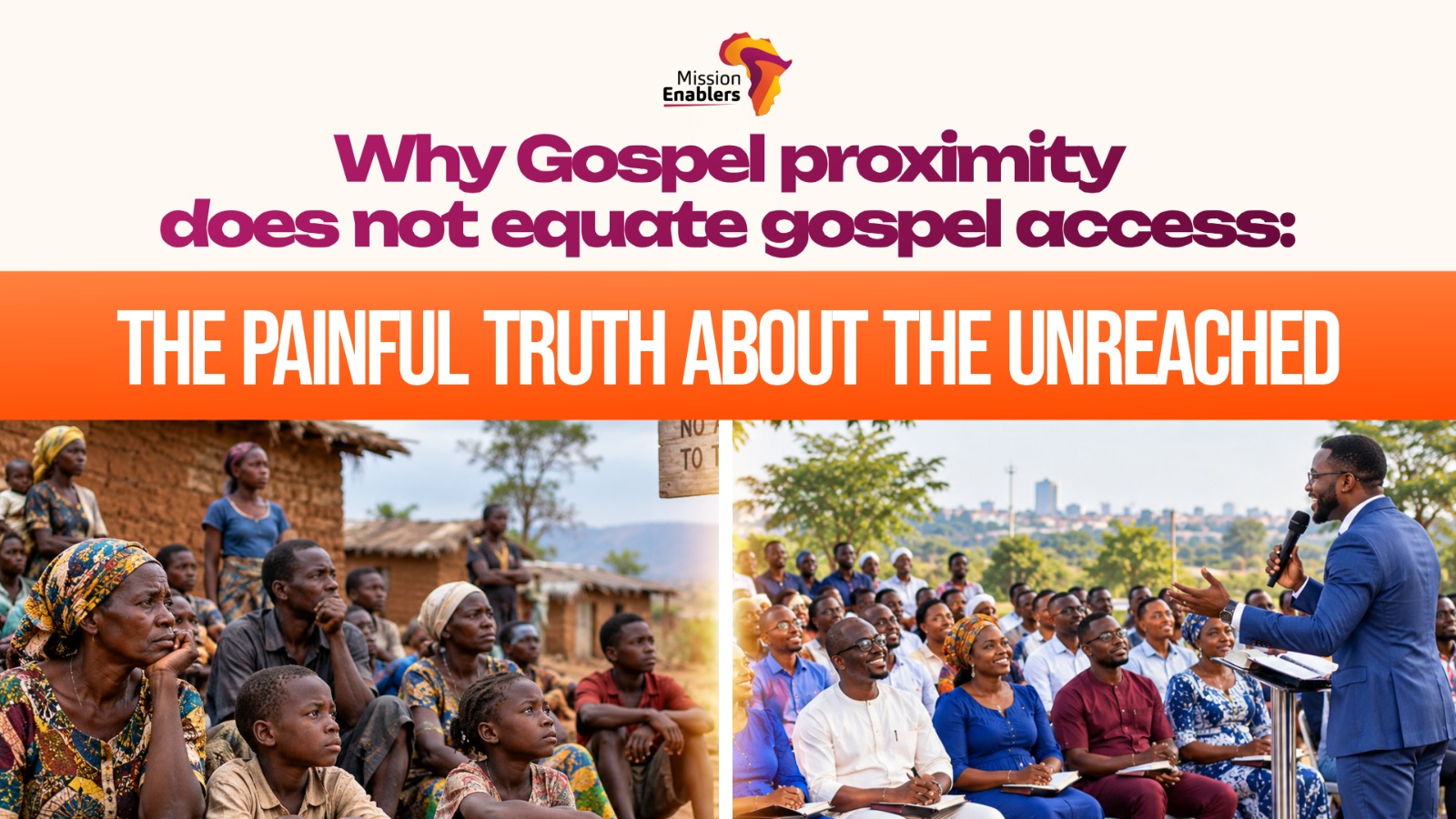
ARE THEY DEAF?
The Painful Truth About the Unreached, Why Gospel Proximity Does Not Equate Gospel Access
Niyi Osomo
THE QUESTION THAT WILL NOT LEAVE ME
Sometimes when we talk about billions of people who remain unreached by the gospel, the numbers are so large that they become difficult to feel. We live in the age of smartphones, satellite television, international travel, social media, digital bibles, Christian television, YouTube, podcasts and churches in almost every Nation. Jesus is one of the most recognised names in human history.
We put a post about the statistics of the UPG and someone in the comment section asked: Are these people deaf? Have they really not heard? That question has stayed with me because the answer exposes one of the most important misunderstandings in modern mission.
Unreached does not mean deaf. It does not necessarily mean that every person in a community has never heard the name Jesus, never seen a Christian or never encountered a church building.
It means something deeper. Gospel proximity does not equal gospel access.
WHAT DOES “UNREACHED” ACTUALLY MEAN?
Mission terminology can become confusing because different research organisations use somewhat different definitions and datasets. The numbers should therefore be treated as strategic estimates rather than inspired categories.
Joshua Project currently defines an Unreached People Group, or UPG, as a people group with 5 percent or fewer Christian adherents and 2 percent or fewer evangelicals. More importantly, the underlying missiological idea is that there is not yet an indigenous community of believing Christians with sufficient numbers and resources to evangelise the wider people group without outside assistance.
IMB uses a closely related but not identical definition, describing unreached peoples in terms of an evangelical population below 2 percent while also warning that percentage thresholds should never become the only measure of gospel access.
That nuance matters. “Unreached” is not a declaration about the eternal condition or personal knowledge of every individual. It is a strategic description of the weakness of indigenous gospel presence and access within a population.
A person can have heard the word “Jesus” and still live in an unreached people group.
THE CURRENT GLOBAL PICTURE
As of September 2026, Joshua Project’s global dataset identifies approximately 16,426 distinct people groups when groups are counted once globally. About 7,162 are classified as unreached, representing approximately 43.6 percent of identified people groups.
Those unreached groups contain roughly 3.62 billion people, about 44 percent of the population represented in that dataset.
Joshua Project also uses a country-specific counting method for some of its tools, in which the same ethnolinguistic people may be counted separately when they live in multiple countries. Under that methodology the totals are lower for globally distinct peoples and different from the people-groups-in-countries dataset. This is one reason mission statistics from reputable organisations can appear to disagree.
The point is not to become obsessed with one number. The point is that after centuries of global Christian expansion, billions of people still live among populations where indigenous gospel presence remains insufficient for the gospel to spread naturally throughout the community without significant outside help.
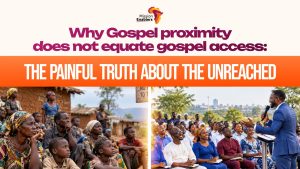
GOSPEL PROXIMITY DOES NOT EQUAL GOSPEL ACCESS
This is the distinction I want the Church to understand.
- A mosque can stand beside a church without the Muslim family next door having meaningful access to the gospel.
- A Hindu can work beside a Christian without ever hearing a clear explanation of who Jesus is in a language and cultural framework he understands.
- A person can live in a city containing hundreds of churches while belonging to an ethnic, linguistic, caste, religious or social community into which those churches have almost no relational access.
- A Christian television station can broadcast into a country while millions of people do not understand the broadcast language, cannot receive the channel, distrust its messenger or face severe social consequences for responding.
- A Bible can exist in the national language while someone’s heart language still lacks adequate Scripture.
- A missionary can live geographically close to a people while cultural, linguistic, political or security barriers keep meaningful witness far away.
That is why proximity is not universality, visibility is not accessibility, and availability somewhere is not meaningful access everywhere.
THE DIFFERENCE BETWEEN EXPOSURE AND ACCESS
We should distinguish simple exposure from meaningful gospel access. Exposure may mean that someone has heard the name Jesus, seen a cross, watched a Christian video or knows that Christians exist.
Meaningful access asks different questions. Is there a believer this person can actually talk to? Is there Scripture in a language he or she understands well? Is there a local church within realistic relational and cultural reach? Can questions be asked safely? Is the gospel being communicated in ways that make sense within the person’s language and worldview? Is there an indigenous Christian community capable of continuing the witness without permanent outside dependence?
That is a much higher standard than simply saying, “The internet exists, therefore everybody can hear the gospel.” Technology has radically increased potential access. It has not eliminated language, censorship, literacy, persecution, caste, ethnicity, geography, family pressure, religious identity or the need for embodied Christian witness.
FRONTIER PEOPLE GROUPS: WHERE THE GOSPEL GAP IS EVEN DEEPER
Another term that needs clarification is Frontier People Group, or FPG.
Joshua Project currently uses this category for an unreached people group with virtually no followers of Jesus and no confirmed sustained movement to Christ. In its current methodology, a frontier group has approximately 0.1 percent or fewer Christian adherents.
In plain language, these are communities at the far edge of gospel access.
Joshua Project’s current global presentation lists about 4,824 frontier groups when groups are counted once globally, while its missions explorer uses a people-groups-in-countries dataset showing about 3,218 frontier groups and approximately 1.9 billion people. The differing figures reflect different counting methodologies, not necessarily contradictory realities.
The important thing is to understand the category: some unreached peoples have missionaries, emerging churches and active gospel work. Frontier peoples have virtually no Christian presence or sustained movement to Christ. They require a pioneer mission.
UNENGAGED DOES NOT MEAN THE SAME THING AS UNREACHED
Then there is another category: Unengaged Unreached People Groups, commonly shortened to UUPGs.
Not every unreached people group is unengaged. A people may be unreached but already have missionaries learning the language, evangelists sharing Christ, churches being planted and believers being discipled. The group remains unreached because the indigenous Christian community is still too small or weak to reach the wider population without outside help.
Unengaged describes a different gap. Joshua Project currently describes an unengaged unreached people group as one for which there is no reported sustained effort focused on establishing self-sustaining churches consistent with evangelical faith and practice. Its current database lists approximately 2,197 such groups, representing about 775 million people.
That number must be used with humility. Joshua Project itself warns that covert, indigenous or unreported work may exist. “Unengaged” therefore means no sustained engagement has been reported through the networks supplying the data; it should not be turned into an absolute claim that God has no witness anywhere in that population.
IMB uses a somewhat different dataset and reports 3,106 UUPGs in its 2026 statistical summary. That difference is another reminder that mission databases use different definitions, sources and counting methods. The terminology is a tool for mobilisation, not a competition over whose spreadsheet is inspired.
WHY CAN PEOPLE REMAIN UNREACHED IN A CONNECTED WORLD?
The barriers are specific.
- Language remains one of the most obvious. Knowing that a Christian message exists in English does little for a person who does not understand English well enough to grasp the gospel.
- Scripture access remains uneven. Having some portion of Scripture available somewhere is not identical to having understandable, affordable and usable Scripture within a community.
- Geography still matters. Remote villages, mountains, deserts, islands, conflict zones and migratory populations can be difficult to reach consistently.
- Religion and social identity matter. In some communities, changing religious allegiance may be interpreted not simply as adopting a new belief but as betraying family, ethnicity, ancestry or nation.
- Persecution and legal restrictions matter. Open evangelism, church planting or conversion may carry serious social or legal consequences in some contexts.
- Caste, clan and ethnic boundaries matter. A church from one social group may exist nearby while having very little credibility or relational access within another.
- Missionary presence matters. Digital content is powerful, but Christianity is ultimately embodied. People need witnesses, discipleship, community, churches and leaders.
These barriers are why “they have the internet” is not an adequate mission strategy.
A CHURCH-FILLED CITY CAN STILL CONTAIN UNREACHED PEOPLE
This is especially important for those of us from places with visible Christianity. We can drive through Lagos, Nairobi, Accra or other African cities and see churches everywhere. We can assume that because Christianity is visible, everybody has meaningful access to the gospel.
But cities contain multiple worlds. There are migrants, minority ethnic communities, Muslims, Hindus, traditional-religion communities, expatriates, refugees, international students, language communities and social networks that may live physically beside strong churches while remaining relationally distant from them.The unreached are not always on the other side of the ocean. Sometimes they are on the other side of a cultural boundary.
THE 10/40 WINDOW STILL HELPS, BUT IT IS NOT THE WHOLE STORY
The term 10/40 Window describes the broad region between approximately 10 and 40 degrees north latitude stretching across North Africa, the Middle East and much of Asia. It remains useful because an enormous concentration of unreached and frontier peoples lives within this region.
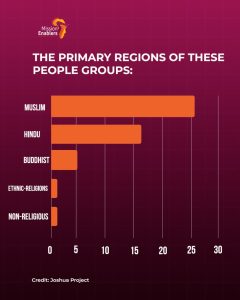
Joshua Project notes that South and Central Asia contain a particularly large share of currently reported unengaged groups, and most UUPGs are associated with Muslim, Hindu or Buddhist contexts.
But the 10/40 Window should not become a map that makes us blind to unreached communities elsewhere.
Migration has moved peoples across borders. Diaspora communities may carry unreached populations into European, North American, African and other global cities. Urbanisation has brought multiple people groups into the same metropolitan areas.
Mission strategy therefore needs both geographic intelligence and people-group intelligence.
THEY ARE NOT JUST STATISTICS
There is a danger in mission research. We can become fascinated with percentages and forget people.
Behind 3.62 billion are fathers, mothers, students, farmers, children, traders, professionals, refugees, neighbours and families. They have names, histories, hopes, fears, languages and communities.
God does not love percentages. God loves people.
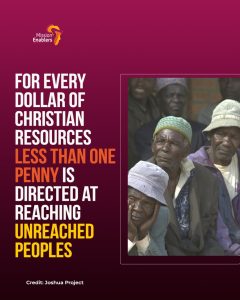
The reason we study the numbers is not so that mission leaders can sound informed. We study them because research can help us identify where gospel access remains weakest and where workers, prayer, translation, resources and partnership are most needed.
Mission data should lead to mission obedience.
THE UNREACHED ARE NOT UNREACHABLE
One of the strongest convictions I carry is this: it is not that the unreached are unreachable. There are specific barriers keeping people unreached.
When we identify the barrier, strategy becomes clearer.
If the barrier is language, learn the language and translate.
If the barrier is lack of Scripture, support Bible translation and oral Scripture.
If the barrier is the absence of workers, pray for labourers, train them and send them.
If the barrier is hostility to traditional missionary identity, explore legitimate creative-access pathways through professions, education, business, humanitarian service and diaspora relationships without deception.
If the barrier is weak indigenous leadership, disciple believers and develop local leaders.
If the barrier is lack of funding, mobilise resources.
If the barrier is ignorance in the Church, mobilise the Church.
The word “unreached” should never become an excuse for despair. It should help us diagnose the gap.
FROM GOSPEL PRESENCE TO GOSPEL ACCESS
A useful mission question is not simply, “Is Christianity present in this country?”
Ask instead: Can these people realistically encounter the gospel through someone they understand and trust? Is there Scripture they can understand? Are there believers within relational reach? Is there a church that can discipline them? Are there workers intentionally crossing the barriers? Can a new believer become part of a community capable of reproducing disciples and churches?
That is the movement from presence to access.
A nation may have millions of Christians and still contain unreached peoples. A city may have megachurches and still contain communities with little meaningful gospel access.
National Christian population and local gospel access are not the same measurement.
WHAT SHOULD THE CHURCH DO?
First, identify. We cannot strategically respond to peoples we have never learned to see.
Then understand. Learn the language, religion, history, worldview, geography and specific barriers affecting gospel access.
Pray. Jesus told His disciples to ask the Lord of the harvest to send labourers.
Resource. Mission requires Scripture, transport, training, technology, member care and money.
Send. Some barriers will never be crossed until somebody physically goes.
Translate. The gospel must be communicated intelligibly, and Scripture should move toward the languages people understand best.
Disciple. The goal is not merely a decision but obedient followers of Jesus gathered into a healthy Christian community.
Develop indigenous leadership. Sustainable mission does not create permanent foreign dependency; it longs to see local believers equipped to evangelise, disciple, lead and send from within their own people. These are not seven disconnected programmes. They are parts of one missionary response.
ARE THEY DEAF?
So let me return to the uncomfortable question. Are they deaf? No.
Many are simply living behind barriers we have not yet crossed.
Some have heard the name Jesus without hearing the gospel clearly. Some live near Christians but outside meaningful Christian relationships. Some have digital connectivity but little trustworthy gospel witness in their language and culture. Some live in places where following Christ may carry enormous cost. Some belong to communities where there is still no reported sustained effort to establish an indigenous church.
The painful truth is not that billions of people are refusing a message that has been equally and meaningfully available to everyone.
The painful truth is that gospel access remains profoundly unequal.
Proximity does not equal access.
Visibility does not equal accessibility.
A church somewhere does not mean a church within reach.
A Bible somewhere does not mean Scripture understood.
A missionary somewhere does not mean a witness among every people.
And an internet connection does not automatically make a disciple.
The unreached are not unreachable.
But if barriers are going to be crossed, somebody must pray, somebody must learn, somebody must translate, somebody must give, somebody must send, and somebody must go.
DATA AND TERMINOLOGY NOTE
Mission datasets change continually as populations change, churches emerge and new field reports are received. Different organisations also define and count people groups differently. Figures in this article reflect sources consulted in September 2026 and should be rechecked before future publication.
Joshua Project’s globally distinct people-group dataset currently reports approximately 16,426 total people groups, 7,162 unreached groups and about 3.62 billion people living among unreached peoples. Its current unengaged database reports 2,197 UUPGs representing approximately 774.5 million people. Its frontier figures vary depending on whether groups are counted once globally or as people-groups-in-countries.
Joshua Project defines a UPG as 5 percent or fewer Christian adherents and 2 percent or fewer evangelicals. It approximates a Frontier People Group as an unreached group with 0.1 percent or fewer Christian adherents and no confirmed sustained movement to Jesus. A UUPG is both unreached and without reported sustained effort focused on establishing self-sustaining churches.
IMB’s 2026 statistics, based on 2025 data, use different methodology and report 7,291 unreached groups and 3,106 UUPGs. IMB explicitly notes that such lists can differ because definitions of engagement and data sources differ.
These categories are missiological tools. They are not biblical labels, and percentage thresholds should not replace field research, prayer, theological judgment or careful attention to actual gospel access.
KEY SCRIPTURE REFERENCES
Genesis 12:1–3, Psalm 67, Isaiah 49:6, Matthew 9:35–38, Matthew 24:14, Matthew 28:18–20, Luke 24:46–49, Acts 1:8, Acts 13:1–4, Acts 17:16–34, Romans 10:13–15, Romans 15:18–24, 1 Corinthians 9:19–23, Revelation 5:9–10 and Revelation 7:9–10.
SELECTED SOURCES
Joshua Project, Global Mission Statistics, Definitions, Frontier Peoples and Unengaged Unreached People Groups, consulted September 2026.
International Mission Board (IMB), 2026 Annual Statistical Report Definitions and Global Summary, based on 2025 data.
IMB, Key Terms: Unreached Peoples and Places.
Finishing the Task, Great Commission mobilisation framework.
Niyi Osomo